
Yellow Jambhala
Room to Give
A figure of royal bearing opens a reading of abundance and generosity. What can the attributes of a wealth deity tell us about the act of giving?
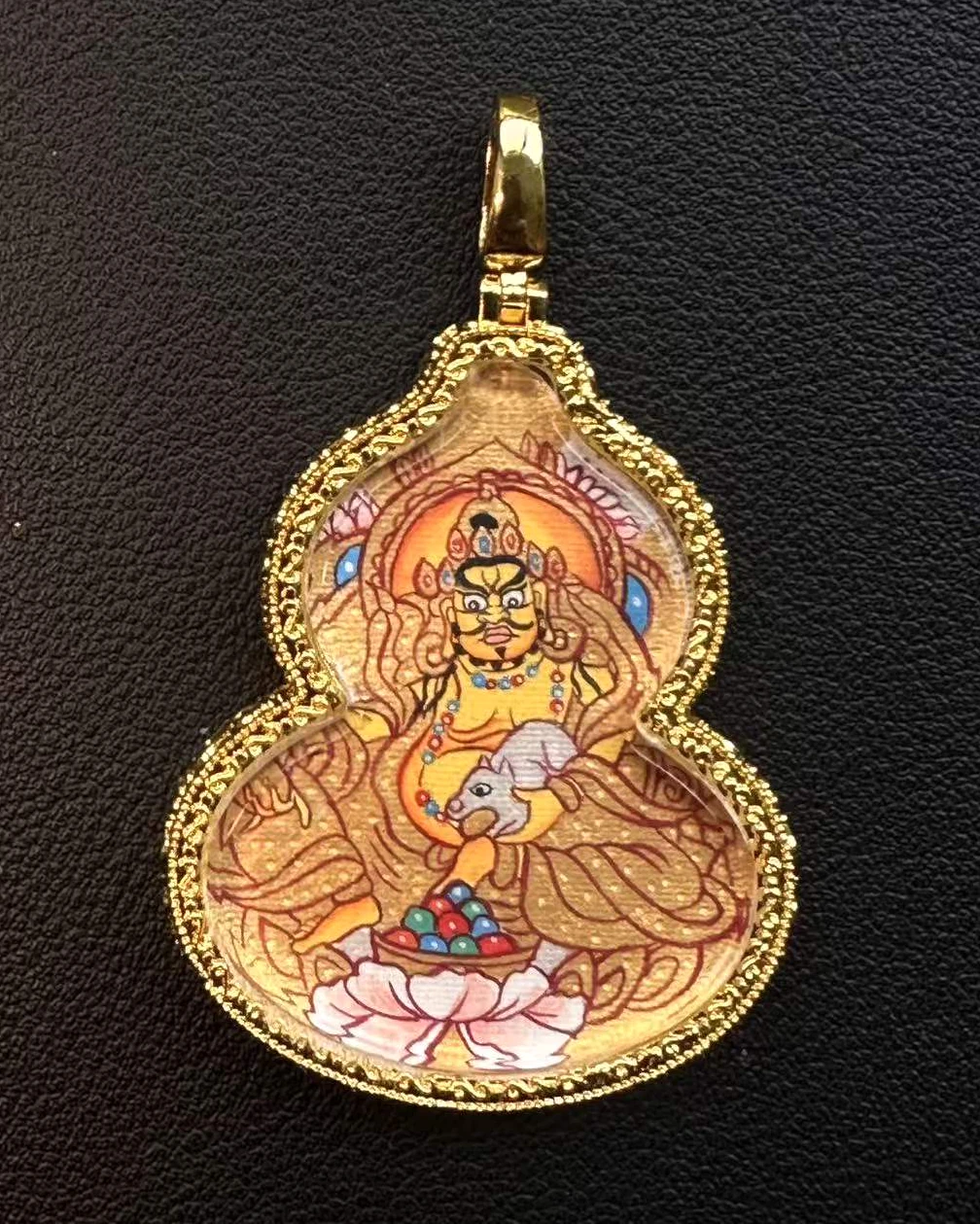
Collection records provide context for the art and its traditions. The subjects in the SECRET SHRINE catalogue are supplied by the merchant. Individual iconographic forms require separate identification.
A golden presence.
Collection or research record
A royal bearing
Yellow Jambhala is a wealth deity in Buddhist art. His full-bodied form, crown and ornaments belong to a royal mode of representation. Early yaksha imagery in India provides a point of reference for this bearing. Name, body and adornment are read together, within a longer history of images.[1][8]
One name. Many forms.
Within a particular tradition
The familiar seated figure
In a familiar two-armed form, the figure’s right hand carries a citron-like fruit and the left a mongoose releasing jewels. A seated sculptural example places him on a lotus, with one leg lowered and supported by a blossom. Posture, hands and attributes belong together when reading a particular form.[1][2]
Within a particular tradition
Different traditions, different arrangements
That form does not exhaust the subject. Another Yellow Jambhala associated with the Guhyasamaja Tantra has three faces and six arms. In a familiar description of Black Jambhala, a dark body and a wrathful face accompany a skull cup in his right hand. Each arrangement asks to be understood within its own tradition.[5][6]
Collection or research record
A shared attribute is not a shared identity
Related figures can share a visual language without sharing a name. Jambhala and Vaishravana both appear with a mongoose. That attribute alone cannot settle an identity; nor does the name Kubera serve as a universal label for wealth figures across the different contexts of Himalayan art.[7]
Room to give.
Within a particular tradition
The mongoose and greed
In one interpretation of Jambhala imagery, snakes signify avarice, while their opponent, the mongoose that releases jewels, is associated with prosperity and overcoming greed. Plenty and the movement away from grasping meet within the same symbolic field.[3]
Within a particular tradition
A wider Buddhist context
In the wider Buddhist understanding of merit, giving to people in need and making offerings are among the positive actions that matter. An account of Yellow Jambhala also brings wisdom into the figure’s religious significance. Wealth is encountered within a broader field of values, rather than as a subject standing alone.[4][2]
SECRET SHRINE reading
What we make room for
For SECRET SHRINE, the thought moves toward the space an object occupies in a life. Enough need not close around us. It can leave room for another person, for attention, for something freely given. A collected object may hold that question quietly: beyond what we can keep, what are we prepared to share?
Return to the painted image.
SECRET SHRINE reading
Looking and knowing
For SECRET SHRINE, care for an image includes clarity about its record. A promise to the painting core belongs beside an honest account of what has been seen and what remains to be learned. Attention becomes a way of staying with the object, without asking it to say more than it can.
Sources
- Yellow Jambhala — forms and contextHimalayan Art Resources
- Yellow Jambhala — collection record M.86.61.3Los Angeles County Museum of Art
- Jambhala — the mongoose and avariceRubin Museum of Himalayan Art
- Merit — a Buddhist conceptRubin Museum of Himalayan Art
- Yellow Jambhala — a three-faced, six-armed formHimalayan Art Resources
- Black Jambhala — a two-armed formHimalayan Art Resources
- Wealth figures — distinctions in identificationHimalayan Art Resources
- Seated Jambhala — collection record 1987.142.320The Metropolitan Museum of Art